How to become a mobile beautician in the UK
Taking your treatments to clients’ homes means low costs, flexible hours and clients who love the convenience. Here’s how to set up properly: training, insurance, kit, pricing for travel, safety and getting booked.
By Adam Rance, founder of Pulosa7 min readChecked
The short version
Train for each treatment, get insurance that covers working in clients’ homes and business use on your car insurance, and build a portable kit. Price your travel time in, take deposits, group bookings by area and register with HMRC once you earn over £1,000.
Get recognised training for each treatment and an insurance policy that covers working in clients’ homes, plus business use on your car insurance. Build a portable kit you can carry and set up quickly, decide how far you’ll travel and price your time on the road into every booking. Register with HMRC once you earn over £1,000 a year and claim your business mileage. Take deposits when clients book, group appointments by area, and always tell someone where you’re going.
Is mobile right for you?
Mobile beauty suits people who want to start with very little money, fit work around family, or serve clients who can’t easily get to a salon: new parents, older clients, carers, brides and busy professionals.
| Good | Harder |
|---|---|
| No rent or premises costs | Time on the road you can’t charge for directly |
| Flexible hours and area | Working in other people’s homes, with their light, pets and space |
| Clients pay for convenience | Carrying and setting up kit for every appointment |
| Bridal and event work | Late cancellations hurt more after you’ve travelled |
1. Choose treatments that travel well
Some treatments are made for mobile work, others are hard to do well in a living room. Popular mobile treatments include:
- Nails: gel polish, BIAB, manicures and pedicures. A compact desk lamp and a good case go a long way.
- Lashes and brows: lifts, tints and extensions, with a portable couch or a lash bed that folds.
- Waxing and threading: quick appointments that are easy to group by area.
- Make-up: bridal and occasion work, often at clients’ homes or venues.
- Massage and facials: with a portable couch and plenty of towels.
- Spray tanning: with a pop-up tent and extraction.
Get recognised training for each one: insurers won’t cover you without it. Our guide to beauty qualifications explains the usual routes.
2. Insurance for working on the move
- Treatment and public liability that specifically covers working in clients’ homes and venues.
- Business use on your car insurance. Most personal policies don’t cover driving to clients, so tell your insurer.
- Equipment cover, including while it’s in your car. Check whether it covers theft from an unattended vehicle, and at night.
Read what insurance do I need for a beauty business for the detail.
3. Build a portable kit
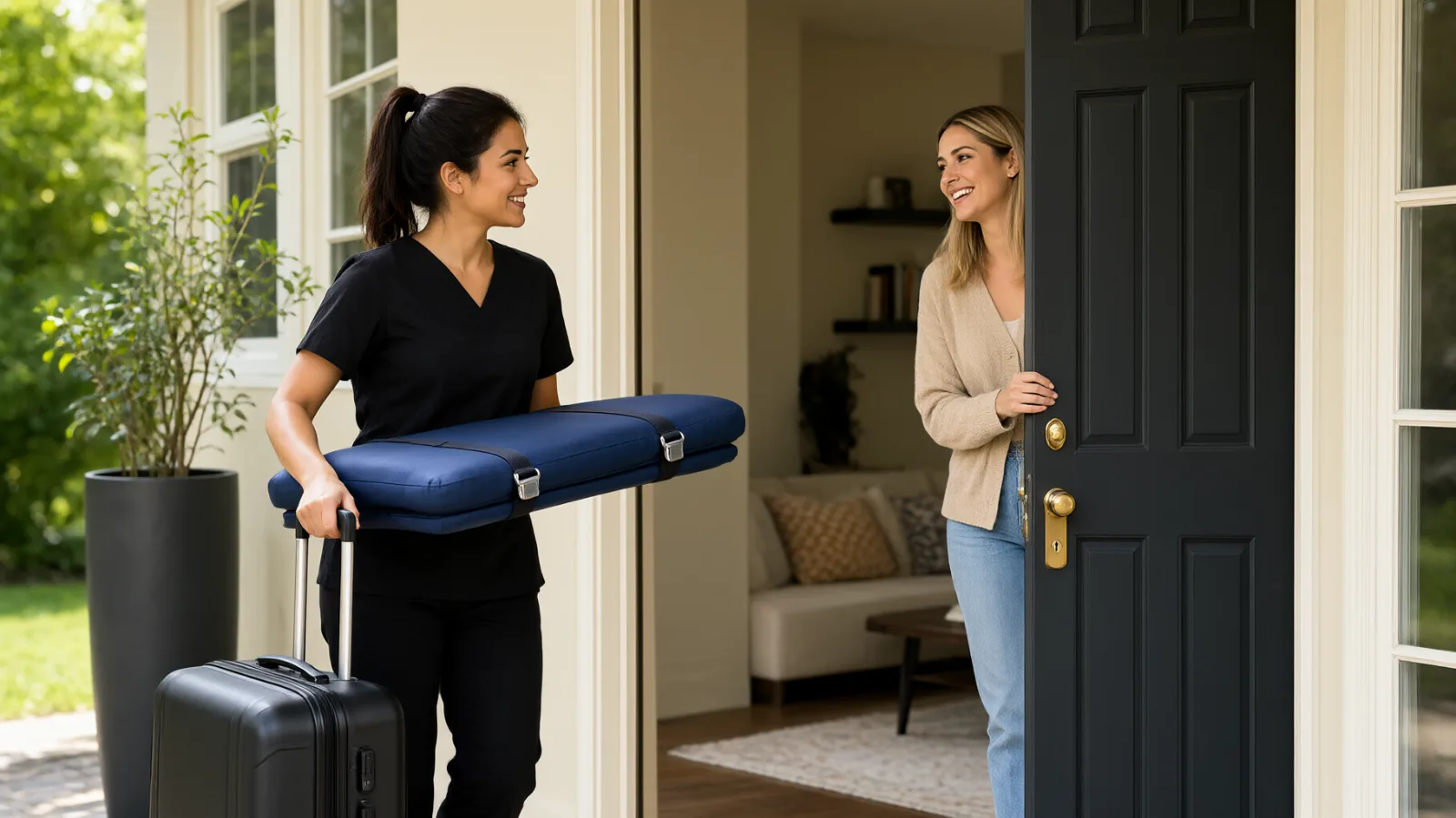
Your kit has to be quick to carry, set up and pack away, and look professional on a client’s kitchen table.
- A wheeled case or trolley, organised so everything has its place.
- A lightweight folding couch, or a lash bed if you do lashes.
- A portable lamp: client homes are rarely well lit.
- Protective sheets for floors and furniture, and a small bin for waste.
- Clean towels and disposables for each client, kept separate from used ones.
- Hand sanitiser and surface wipes, so you can clean before and after.
- Spare everything: a missing file or a flat battery can end an appointment.
4. Decide where you’ll go
Set a clear area, such as your town plus a few miles, or a list of postcodes. Charging extra for further away keeps long trips worthwhile. Grouping appointments by area on certain days cuts your driving: for example, one side of town on Tuesdays and the other on Thursdays.
5. Price for your time on the road
Mobile clients pay for convenience, so you don’t need to undercut salons. Work out what each appointment really costs you, including the time and fuel to get there.
- 1Add up the product cost of each treatment.
- 2Add your share of fixed costs: insurance, training, kit, phone, software and marketing.
- 3Add your time, including travel and set-up, not just the treatment itself.
- 4Add fuel and wear on your car, or a travel charge for anywhere outside your main area.
- 5Set a minimum spend for home visits, so a quick brow tint isn’t a loss.
6. Stay safe
Going into strangers’ homes is the part of mobile work most people worry about, with good reason. A few simple habits help:
- Take bookings through your booking system, with a name, address, phone number and deposit, not anonymous messages.
- Share your diary with someone you trust, and check in when you arrive and leave.
- Trust your instincts. If something feels wrong, you can leave.
- Keep your phone charged and your car keys to hand.
- Be cautious about first-time clients at night or in places you don’t know.
7. Tax and mileage
Register with HMRC for Self Assessment by 5 October after the tax year in which you first earn more than £1,000. Keep a log of every business journey: driving to clients is a business cost.
You can claim the actual costs of running your car for business, or use HMRC’s simplified mileage rate (opens in a new tab). From 6 April 2026 that’s 55p a mile for the first 10,000 business miles a year and 25p a mile after that.
Free toolSelf-employed tax calculatorSee roughly how much tax and National Insurance you’d pay on your profit.8. Setting up bookings and payments
For a mobile business, booking software isn’t just convenient, it’s part of staying safe and paid. Look for:
- Online booking that takes the client’s address and phone number up front.
- Deposits when they book, so a door that doesn’t open doesn’t cost you a wasted trip.
- Reminders the day before, with what to have ready (a table near a socket, pets out of the room).
- Consultation and consent forms completed before you arrive, so you don’t fill them in on a client’s sofa.
- Taking card payments on the spot with a card reader or a payment link.
A day in the life: planning your route
The difference between a profitable mobile day and an exhausting one is usually planning. A good day looks like this:
- 1Appointments grouped in one area, with the longest one first while you’re fresh.
- 2Time between each one for packing up, driving, parking and setting up.
- 3Your kit restocked the night before, with spares in the car.
- 4Clients reminded the day before with what to have ready: a table, a socket, good light and pets out of the room.
- 5A buffer at the end of the day for traffic or a late start.
Track how long each kind of appointment really takes door to door for a few weeks. Then build those times into your booking slots so you’re never rushing.
Weddings, events and care homes
Mobile beauticians can earn well from work salons can’t easily do. Bridal parties, proms, hen parties and corporate events book several treatments at once. Care homes and hospices often welcome a regular visiting nail tech or hairdresser. These clients usually book ahead and pay deposits, which makes your diary more predictable. Have a separate price list and terms for group and event bookings, including travel, timings and what happens if the event moves.
9. Get your first clients
- 1Set up a Google Business Profile as a service-area business: you can show the areas you cover without showing your home address.
- 2Join local Facebook groups and post when you have slots in each area.
- 3Partner with local businesses: wedding venues, care homes, gyms and hairdressers.
- 4Ask every client for a review and a referral. Mobile work spreads by word of mouth on the same street.
- 5Rebook before you leave, so your next visit to that area is already in the diary.
More ideas in how to get your first 50 clients.
Questions people ask
Do I need a licence to be a mobile beautician?
Most mobile beauty treatments don’t need a council licence, but treatments like semi-permanent make-up, piercing and electrolysis need council registration even if you’re mobile. Check with your council.
What insurance do mobile beauticians need?
Treatment and public liability that covers working in clients’ homes, business use on your car insurance, and cover for your equipment, including while it’s in your car.
How much should I charge for travel?
Many mobile beauticians include travel within a set area and add a charge further out, or set a minimum spend for home visits. Make sure your prices cover your time on the road as well as the treatment.
Can I claim mileage as a mobile beautician?
Yes. Business journeys to clients are a business cost. From 6 April 2026, HMRC’s simplified rate is 55p a mile for the first 10,000 business miles a year and 25p after that.
How do I stay safe as a mobile beautician?
Take bookings with full details and a deposit, share your diary with someone you trust, check in when you arrive and leave, and trust your instincts.
Sources
Rules change, so we check these and update the guide. Always confirm anything legal with the source, your council or an adviser.